
Can Glow in the Dark Powder Pass FDA or EN71-3 Testing?
In recent years, the use of glow-in-the-dark powder in areas such as tableware, children’s toys, and infant products has become increasingly widespread. Its safety has drawn significant attention from brands, manufacturers, and consumers. Whether glow-in-the-dark powder passes stringent international testing standards, such as the FDA (U.S. Food and Drug Administration) food contact material standard and EN71-3 (EU toy safety standard), has become a crucial factor for many food-grade product manufacturers to assess its safety. They believe that only passing these tests can ensure its reliability and compliance for use in food and oral contact materials, and the product’s can be more safety and give consumers peace of mind.
Common food safety tests fall into two main categories:
1. Exemplified by EN71-3, examines the migration of chemicals after a sample being swallowed.
2. Exemplified by FDA testing, examines the migration of chemicals after a sample comes into contact with the oral cavity. The methods and solutions used in these tests often vary significantly depending on the material.
However, as a pigment with luminous function, glow-in-the-dark powder has fundamentally different material properties from conventional food contact materials, making it unsuitable for direct food safety testing using powder alone.
The reasons are analyzed in detail below by examining the material properties of luminous powder and the testing procedures of EN71-3 and FDA:
1. Glow in the Dark Powder Material Properties:
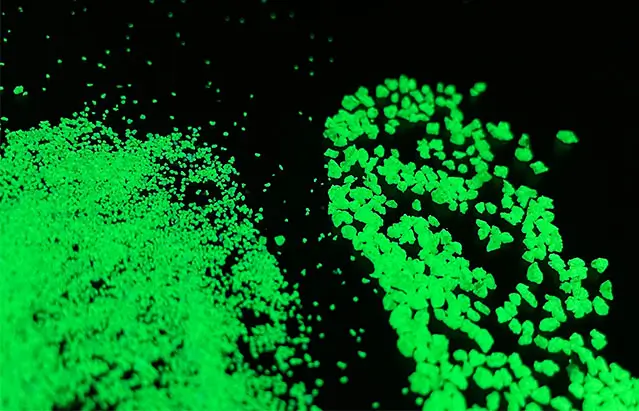
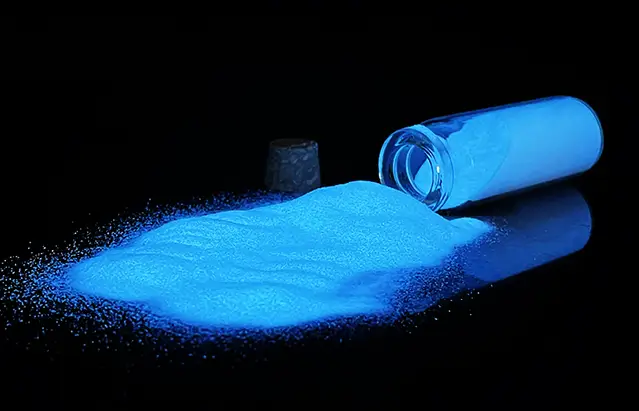
Glow-in-the-dark powder is an inorganic luminescent granular powder material. It cannot be ground or dissolved, or be used exposed for use. It must be mixed with a transparent or translucent substrate, such as a coating, plastic, or silicone etc. liquid medium, to produce the final product. These materials encapsulate the luminescent crystals and protect them from damage.
See Real Cases
Learn why some luminous powders successfully pass EN71-3 testing while others fail.
Read more →
2. FDA Food Contact Material Regulation
Glow-in-the-dark powder is an inorganic luminescent granular powder material. It cannot be ground or dissolved, or be used exposed for use. It must be mixed with a transparent or translucent substrate, such as a coating, plastic, or silicone etc. liquid medium, to produce the final product. These materials encapsulate the luminescent crystals and protect them from damage.
The core focus of FDA food contact material testing is:
- Assessing the risk of material migration into food under the intended use conditions (including temperature, time, and food type).
- Focusing on potential migration of toxic heavy metals (such as Pb, Cd, and Hg), small organic molecules (such as plasticizers and antioxidants), and monomer residues (such as Bisphenol A and Formaldehyde).
- Testing targets: The final product must be tested, NOT the raw material, as migration behavior is directly affected by substrate properties (such as plastic crystallinity) and processing techniques (such as injection temperature).
- Test method requirements: The sample must have a defined physical form (sheets/blocks/molded parts, etc.), the surface contact area must be accurately calculated.
(1) Can glow-in-the-dark powder be directly tested by the FDA?
NO. Glow-in-the-dark powder fails to comply with the testing criteria for both the test object and the test method. It is a powdered raw material and lacks a stable surface for direct contact, making it unable to simulate real-world use scenarios. The FDA has no established test method for raw powder materials.
(2) Can glow-in-the-dark end-use products pass FDA food contact material safety testing?
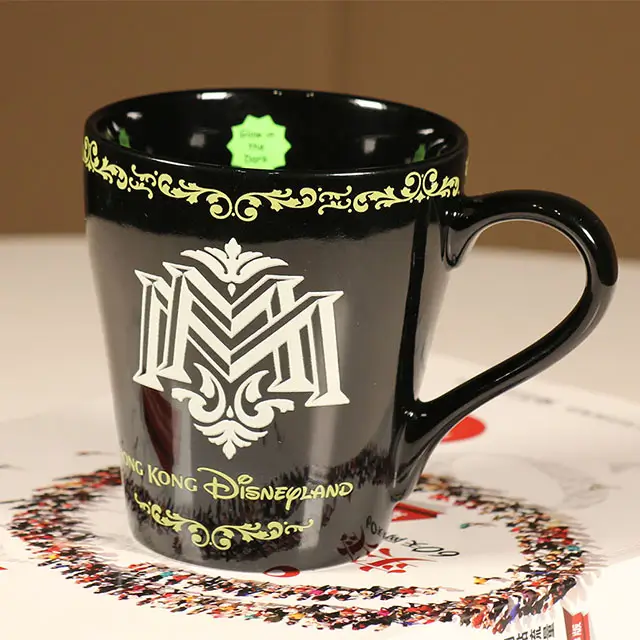
YES. Starbucks tumbler and Disney mugs are prime examples. When applied, glow-in-the-dark powder must be mixed with specific plastic or ink. Once the mixture and medium solidify, the glow-in-the-dark powder is completely encapsulated by the medium. As long as it is intact, it can pass FDA testing.

3. EN 71-3: EU Toy Safety Directive – Part 3: Migration of Certain Elements
EN71-3 primarily tests the migration of 19 specific heavy metals from toy materials. It aims to protect children from health hazards from ingestion or exposure to harmful elements if they accidentally swallow toys.
(1) Can glow-in-the-dark powder be tested under EN71-3?
YES. Laboratories technically accept glow-in-the-dark powder samples, but from a compliance logic perspective, it doesn’t align with the original intent of safety testing standard, nor does it provide meaningful reference for evaluating product safety.
※ Technical Level: EN71-3 Testing Method
- Place the test object in 0.07 mol/L hydrochloric acid (pH ≈ 1.2) to simulate the digestive environment of the human stomach.
- After immersion for 2 hours, test for the migration of 19 hazardous metal elements (such as Pb, Cd, and Sr).
※ Applicable Logic: The testing logic is conflicting and fundamentally mismatched
EN71-3 applies to contactable surfaces of materials in toys and children’s products, such as plastic parts, coatings, wood, and metal parts. This test is designed to assess the migration risk from actual contact or ingestion by children. However:
- Glow-in-the-dark powder is a raw material powder and is NOT final form that comes into direct contact with children.
- Even if the test passes, it does not prove that toys or products made with it will comply with regulations. Separate testing of the final toy or product materials is required for confirmation.
(2) Technical analysis of certain glow-in-the-dark powders passing EN71-3 testing
Currently, glow-in-the-dark powders can be categorized into two main types: Strontium Aluminate type and Zinc Sulfide type. Their performance in the EN71-3 test differs significantly.
※ Strontium Aluminate (SrAl₂O₄) luminous powders:
This type is sensitive to extreme pH values. It decomposes in strongly acidic (pH 0-3) or alkaline (pH 11-14) environments.
- Detection Inconsistency: The used hydrochloric acid solution in EN71-3 (strong acid, pH ≈ 1.5) completely destroys the powder structure, rendering the test results ineffective.
- Key Risk: The decomposition process may release strontium – a heavy metal strictly regulated under EN71-3 – potentially resulting in excessive migration of this element.
Therefore, Strontium Aluminate glow-in-the-dark powders will fail the test.
※ Zinc Sulfide (ZnS) luminous powder
A client once successfully passed the EN71-3 test using Zinc Sulfide (ZnS) luminous powder (Detailed case stud: Why Some Glow-in-the-Dark Powders Pass EN71-3, While Others Do Not).
The critical reason Zinc Sulfide phosphor can pass the test lies in the unique combination of testing method limitations and material properties. However, it’s essential to note that this doesn’t guarantee absolute safety. Detailed analysis is in the following:
- Zinc Sulfide is relatively stable in the test solution (at pH ≈ 1.5 the dissolution rate is approximately 5-15%).
- Although Zinc (Zn) is included in the test list, the limit is relatively loose (≤3700 mg/kg), and its dissolution level is generally below the limit (actual measurements typically range from 500-2000 mg/kg). However, if children repeatedly chew on the material over a long period of time, the cumulative Zinc intake may exceed the standard.
- In acid conditions, Sulfur primarily converts into toxic Hydrogen Sulfide gas (H₂S), a substance outside the analytical scope of EN71-3.
Therefore, while Zinc Sulfide glow-in-the-dark powder can pass EN71-3 testing, the potential risks still exists.
(3) Can glow-in-the-dark end-use products pass EN71-3 safety testing?
YES. As long as practical application scenarios are considered, correct testing logic is followed, and proper sampling is used, glow-in-the-dark end-use products can pass EN71-3 testing. The following case study from our communications with Starbucks exemplifies this point.
Starbucks Case Study:
As a globally renowned brand, Starbucks always prioritizes product quality and material safety. When developing its glow-in-the-dark plastic cups, Starbucks chose our glow-in-the-dark powder to produce glow-in-the-dark masterbatch, which was then mixed with food-grade plastic raw materials for injection molding.
To ensure its products meet international safety standards, Starbucks proactively sent their glow-in-the-dark plastic cup samples for EN71-3 testing in the early development stage. However, the initial test failed. This result took Starbucks attention.
In order to find out the cause, the Starbucks technical team engaged in in-depth technical discussions with us. Through these discussions,we learned that Starbucks had crushed the entire plastic cup sample into fine particles for testing, as required by EN71-3. The testing laboratory, following standard procedures, immersed the particles in a strong acid solution (pH ≈ 1.5) for two hours. The results revealed excessive levels of Strontium.
Test Result Analysis:
In the production process for glow-in-the-dark plastic cups, the glow-in-the-dark masterbatch and plastic raw materials are melt-blended and then injection molded into a dense cup body. During this process, the glow-in-the-dark powder is completely encapsulated by the base plastic, preventing it from coming into contact with the outside world under normal use. However, according to EN71-3, the original intact sample must be mechanically crushed into particles or fragments ≤5mm x 5mm prior to submission for testing. This protocol simulates the physical wear and tear that may occur after long-term use, such as children’s chewing or dropping. This forced crushing process results in:
- Destruction of the integrity of the plastic matrix
- Direct exposure of the originally encapsulated luminescent powder
- Chemical degradation of the exposed luminescent powder under strong acid (pH ≈ 1.5) immersion conditions
- Dissolution and release of Strontium element
This series of physical and chemical changes ultimately resulted in the sample failing the migration test. Providing the test object in this manner not only violates the test suitability logic, but also demonstrates that it cannot provide effective assurance of product safety.
Proposed Solution:
Based on the above analysis, we provided Starbucks with a targeted recommendation: Test the luminescent masterbatch directly rather than the end product. The reasons are:
- In actual use, even if children chew on the plastic cup, the plastic cup remains intact, and the glow-in-the-dark powder is completely encapsulated within the plastic matrix, posing no direct exposure risk.
- The masterbatch size (2-3mm) meets the EN71-3 requirements for homogeneous materials.
- This method better reflects the material’s actual state in the end product.
Starbucks adopted our advice and successfully passed the second EN71-3 test using the glow-in-the-dark masterbatch. After passing several other safety tests, their glow-in-the-dark plastic cups were successfully launched.
In summary, glow-in-the-dark powder is NOT suitable for direct FDA or EN71-3 testing.
When conducting safety assessments of glow-in-the-dark products, a scientific testing plan should be designed based on the material’s actual form and usage conditions in the end product. When the glow-in-the-dark powder is permanently encapsulated in the end product (e.g., fully encapsulated by injection molding) and poses no exposure risk during its lifecycle, independent testing using downstream products (such as glow-in-the-dark masterbatch) as raw materials is a more reasonable and scientific approach.



 + 86(411) 82479386
 Global Financial Center, No. 33 Huizhan Road, Shahekou District, Dalian, China