Home | Glow in the dark powder | Features | High Temperature Resistance Glow in the Dark Powder
HIGH TEMPERATURE RESISTANCE GLOW IN THE DARK POWDER
1. Can Glow in the Dark Powder Be Used in High Temperatures?
When applying luminous powder to high temperature production (such as plastics, silicone, rubber, glass, ceramics, etc.), many customers will worry about whether high temperature will affect the luminous effect. In fact, under certain production conditions, the performance of luminous powder will not be greatly affected.
When discussing the high temperature resistance of luminous powder, customers usually have a misunderstanding that the temperature tolerance is a fixed limit: They suppose the powder can be used below a certain temperature but becomes unusable beyond it. However, the actual situation is not the case. The effect of high temperature on the luminous powder is gradual: The higher the temperature and the longer the firing time, the weaker the luminous brightness. This attenuation occurs gradually, and there is no single critical temperature.
2. Heat Resistance Test
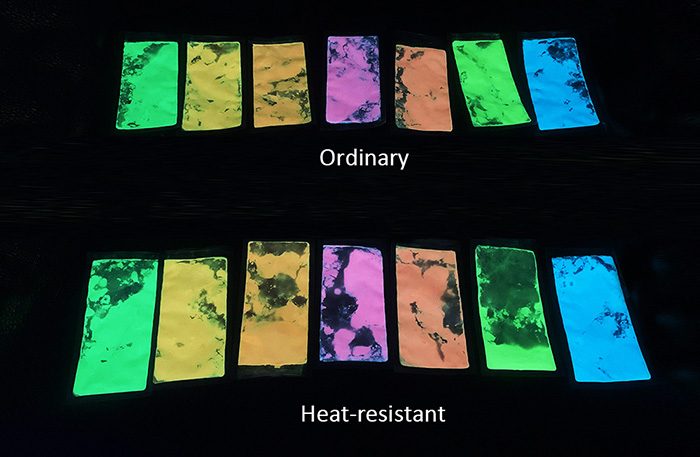
The following experiment can more accurately illustrate how temperature influences the luminous performance, providing a more intuitive and rigorous reference for temperature use in details. The experiment used Yellow-Green 25-35μm both water-based and non-water-based powders for testing (these powders has a wider range of applications), and observed the results after firing in an open kiln for 4 hours, and the following conclusions were drawn:

- Under the same firing conditions, starting from about 600 degrees, non-water-based powder’s body color began to turn white and the brightness get to weaken, while the water-based type has significantly slower change, so the water-based powder is more resistant to firing than the non-water-based one.
- In the experiment of 200℃-500℃, the body color and brightness of the both types did not change significantly. But from 500-600℃, both of them began to show a slight decrease in brightness. Therefore, around 500℃ can be regarded as the range where the luminous effect begins to be apparently affected.
In addition to the above experiments, based on multiple customer cases, there are some other summaries:
- Under the same conditions, Blue-Green is the most heat-resistant color because its particles are the hardest among all the colors, thus can withstand higher temperatures.
- Under the same conditions, larger particles are more heat-resistant. Due to the close relationship between particle size and production process, it is necessary to choose according to the process.
3. Two Major Categories & Applicable Luminous Powder Types
Based on the above experimental results, according to the different production materials, the processing temperature can be roughly divided into the following two categories:
(1) < 500℃
The materials involved in this range are mainly plastics, silicone, rubber, and etc. The melting, curing and vulcanization of them usually have no effect on the luminous performance of natural colors (including 3 colors: Yellow-Green, Blue-Green, and Sky-Blue, which are naturally produced from the production line).
However, when dyed colors (including 8 colors, which are mixed by nature colors and fluorescent powders) is required, the temperature usually needs to be lower, because fluorescent powder cannot resist high temperature.
Most conventional fluorescent pigments exhibit a temperature resistance threshold of 170-180°C. Beyond this range, their body color tends to fade. In contrast, our dyed luminous powder series offers superior heat resistant performance, maintaining color integrity under conditions as:
- 210°C for 60 minutes
- 280°C for 5 minutes
without observable fading.
For this part of the application, the following luminous powders are available:
| GlowUp® Series | Glow Color | Particle Size | Suitable Temperature |
|---|---|---|---|
| YG/YGH/YGQ/YGZ | Yellow-Green | 30±5μm | < 500℃ |
| 25±5μm | |||
| 12±2μm | |||
| 6±2μm | |||
| BG | Blue-Green | 30±5μm | |
| 25±5μm | |||
| 15±3μm | |||
| SB | Sky-Blue | 25±5μm | |
| Dyed color series* | 30±5μm | < 280℃ | |
| Note: Dyed color series temperature resistance is related to heating time | |||
(2) 500℃ to 1500℃
The heating temperatures for glass and ceramics are typically within this range. For instance, low-temperature glass melts at around 700–800℃, while high-temperature glass melts at approximately 900–1000℃. Ceramic glazes have a significantly higher melting point, usually exceeding 1000℃, and can even reach 1400–1500℃. When heating within such temperatures, there are three key factors affecting luminous performance: Kiln Type, Heating Time, and Heating Temperature.
- Kiln type:
Kiln types are mainly divided into “closed kilns” and “open kilns”. The interior of a closed kiln is an oxygen-free environment, where luminous powder can withstand high temperatures of 1400–1500℃. However, such kilns are not common. Most kilns are open kilns, which are oxygen-containing environments, and in such cases, the heating resistance of luminous powder is relatively lower.
- Heating time:
The longer the luminous powder is exposed to heat, the greater the degradation of its luminescent brightness, resulting in diminished glow intensity.
Therefore, under the production conditions of 500-1500℃, the lower temperature the better, and the shorter heating time the better. For more detailed information, please refer to the Glass and Ceramic Application Guide.
For this application, the following luminous powders are available:
| GlowUp® Series | Glow Color | Particle size | Suitable Temperature |
|---|---|---|---|
| YG | Yellow-Green | 250μm | 500℃-1500℃ |
| 105±10μm | |||
| 50±5μm | |||
| BG | Blue-Green | 105±10μm | |
| 50±5μm | |||
| 15±3μm | |||
| SB | Sky-blue | 50±5μm | |
| Note: Specific type depends on the product design, production conditions, etc. | |||
4. Why Does Different Product Situation Affect the Selection of Luminous Powder?
When selecting the powder type for our customers, we will evaluate multiple factors, including product design, performance requirements, cost efficiency, material compatibility, production methods and etc. The following examples will explain how we choose the suitable type to meet each product’s unique requirement:
 The product has certain elasticity requirements, and its production process makes the product have a seam on the base. The customer also requires the cover body with multi colors in daytime. Based on this, we recommend: dyed color series with 20-30 microns type, because it is colorful during the day, and the particle size of 20-30 microns suits the elasticity requirements at the appropriate addition ratio, while maintaining a good luminous brightness.
 The product adopts injection molding process with ABS (a plastic material), and is supplied to underground mining workers. Given its application in safety-related scenarios, it has high requirements for brightness and afterglow duration. So we recommend the plastic-specific type with Yellow-Green color of ultra-high brightness level with a particle size of 25-35μm. The reason is the plastic-specific type can reduce blackening problem during injection. The other factors can comprehensively ensure that the helmet achieves the highest brightness and the longest afterglow, making it suitable for safety applications.
 Starbucks has high requirements for the glowing effect of its products, which not only need to be high, but also a transparent luminous effect. We recommend the ultra-high grade with a particle size of 20-30μm. Although it is not as bright as the 25-35μm type, it can make the product’s luminescence more transparent due to its better coverage, resulting in a better appearance.
 Because the tube wall is very thin, we chose Blue-Green color with an ultra-fine particle size of 12-15μm. Regular particle size types cannot meet the requirements of the tube wall dimensions. At the same time, Blue-Green is the most heat-resistant color among all colors, and is more suitable for high-temperature production of glass. However, the price of this type is slightly higher, and it is only suitable for products with relatively high unit price.
 The product needs to be luminous throughout with Yellow-Green color. And due to ceramic firing temperature is quite high, we chose large-particle of 95-115μm which is more resistant to heat.
 The customer wanted to create a starry glowing effect with a higher brightness, so large particles of 22-280μm with Yellow-Green were selected, and we advised customers to sprinkle them inside the product during the blowing process, and then fire it for a short time.
To summarize, the selection of luminous powder is not a generalization, but requires a full understanding of the design purpose, application environment, production method, and specific requirements for appearance and performance of the end product.
We always insist on in-depth understanding of customer needs, combining the characteristics of the product itself, and comprehensively considering multiple dimensions such as particle size, color, brightness, and adaptation process to recommend the most suitable type of luminous powder to customers, which not only guarantees product performance, but also improves the overall quality and aesthetics.

 + 86(411) 82479386
 Global Financial Center, No. 33 Huizhan Road, Shahekou District, Dalian, China