
glow in the dark powder mixed with Rubber & Silicone
- Non-toxic, non-radioactive, and eco-friendly
- Can be mixed with transparent, colorless neutral rubber and silicone materials
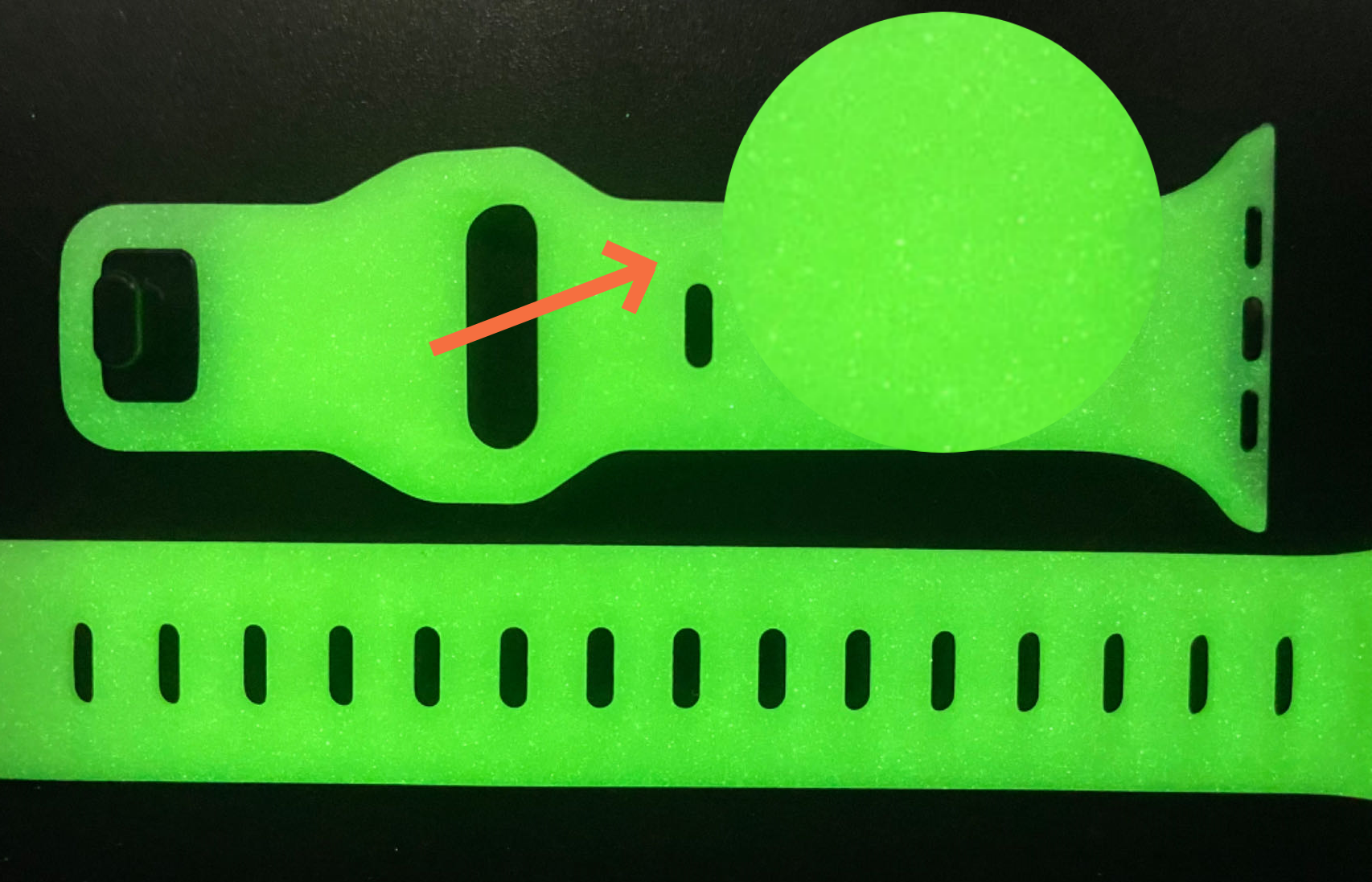
- Used for making various silicone rubber products like accessories, toys, household goods, pendants, watches, and straps
- Available in many colors and particle sizes, selection depends on use and process requirements
- Customer’s requirements for surface smoothness and product thickness affect particle size selection


1. Rubber & Silicone Types for Glow in the Dark Applications
2. Common Applications of Glow in the Dark Rubber & Silicone.
Glow in the dark Rubber & Silicone are often used to make crafts, toys, househould, decorations etc.

3. Safety of Glow in the Dark Powders
4. Glow in the Dark Powder Proportion in Rubber & Silicone
The proportion of glow in the dark powder added to silicone and rubber has a direct impact on the luminous effect of the product. The more powder added, the better the luminous effect will be, but there are other important factors to be considered:
- Product Structure:
If the structure of the product is designed to be closed by different parts (with seams) rather than one-time molding, then the proportion of luminous powder added is recommended to try from a smaller amount, such as 2%-4%. Glow in the dark powder is a granular powder, similar to fine sand. It will not dissolve when mixed with silicone and rubber. If it is added excessively, it may cause the problem that the seams cannot be completely closed.
If the product is made by one-time molding, such as silicone ball, silicone bracelet, etc., you can try to add a higher proportion, such as 20-30% to get a better luminous brightness.
- Elasticity:
When the product requires high elasticity, such as rubber gloves, condoms, etc., if the addition ratio is too high, it will lead to a decline in elasticity and problems such as easy to break. Therefore, it is recommended to control the initial addition ratio at 1-2%, and gradually find out the optimal addition amount on this basis.
- Thickness:
For products with thin thickness, such as rubber gloves, condoms, etc., we need to specify the exact thickness of the product. Based on this information, we will recommend the appropriate particle size of luminescent powder. In the production process, it is also suggested to try 1-2% as a priority in order to accurately grasp the production possibility.
5. Color Choices for Glow in the Dark Powder
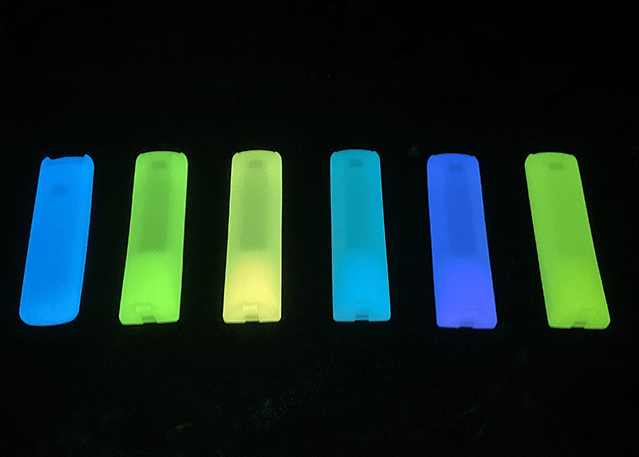
GlowUp® powder include 19 colors totally across three series: 4 in Natural Color Series, 8 in Dye Color Series, and 7 in Orange-Red Series. These colors have different properties, making them suitable for different applications and requirements.
(1) Differences in color properties and applications
- Natural Color Series
The body color of this series is milky white or grayish white. It offers the highest brightness and the longest afterglow duration, with a minimum visual perception of 8-10 hours in a completely dark indoor environment. High brightness grade can reach 10-12 hours.
This series is suitable for products that require high brightness and long-term illumination, such as safety and emergency signage, outdoor markings, or some consumer products that have high requirements.

This series provides a variety of body colors during the daytime, but their glow brightness is lower and the afterglow time is shorter. They can be perceived by the naked eye for about 2-3 hours in a completely dark indoor environment. They are suitable for products requiring colorful appearance in the daytime and can accept lower glowing brightness. The applications include clothing patterns, toys, accessories, and craft items, etc.
This series is a physical mixture of the natural color series and fluorescent powders. Customers can also mix according to their own specific needs.

The body color of this series is milky white or orange-red (the two orange-red powders have a distinct odor). This series has the weakest afterglow brightness and the shortest glow duration, with only a few minutes to around half an hour. Due to its cost being the highest among the three series, its common applications are art painting, jewelry, or some high-value products.

(2) Differences between glow in the dark powder and ordinary dyeing pigments
For ordinary color pigments, for a certain application, customers only need to get the color card and choose what they like, but luminous powder can’t be like this. There are some differences in the characteristics and performance of different colors of luminous powder. The choice of color is determined by the usage. We will communicate with customers about their specific needs for the end products, such as daytime body color, brightness requirements, production methods, and budgets, etc., so as to accurately select the applicable colors for the customers.
(3) Custom colors by RAL or Pantone code
We are unable to offer color customization based on RAL or PANTONE color codes because:
Color matching conditions require color stability and reproducibility in order to tailor formulations to specific color standards. However, the body color of luminous powder is significantly affected by the ambient light and cannot be reproduced and kept stable. Different intensities of irradiation light and the duration of irradiation will make the luminous powder emit different brightness of light, thus showing different body colors.
When the luminous brightness is greater than the brightness of the surrounding environment, the body color of the luminous powder will appear as a brighter Yellow-Green. With the continued release of light for a period of time, the luminous brightness is close to the ambient brightness, the luminous powder body color will return to the body of milky white. This is a dynamic process, so the luminous powder body color will continue to change, and there is no fixed reproducibility.
Therefore, when using luminous powder to match colors, it is not possible to achieve accurate color matching based on RAL or PANTONE color numbers.
(4) The body color of dyed glow powders may not always match their glow color
Basically, for dyed glow powders, the body color and glowing color are nearly the same, but there are a few exceptions. Take the Pink-Red dyed glow powder as an example. This glow powder is made by natural Yellow-Green with pink fluorescent powder physically mixed together.
For body color: The natural Yellow-Green has a milky white body color, but when mixed with pink fluorescent powder, the base color appears pink, which is the Pink-Red color.
For glowing color: The natural Yellow-Green ones emit a Yellow-Green glow. However, when mixed with pink fluorescent powder, the two colors combine, resulting in the final glow color as orange.
This example shows that some dyed glow powders may have a different base color and glow color. This phenomenon is determined by the properties of light combination, and it’s important to keep this in mind when using.

6. Production Temperature
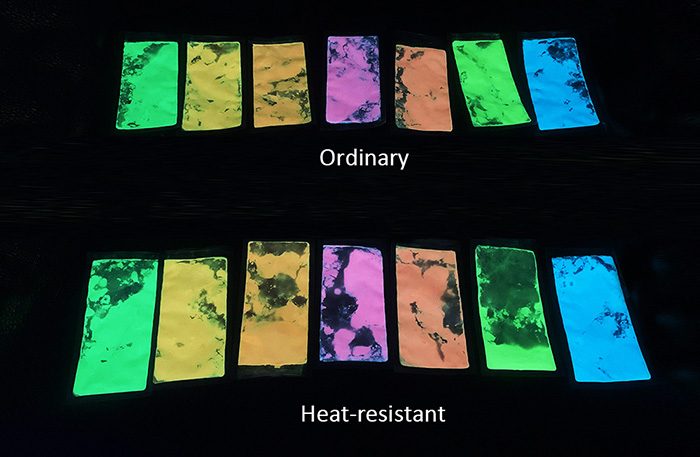
Some silicone or rubber products involve vulcanization during production. When entering the vulcanization process, the products generally need to withstand a temperature of about 130 – 200 ℃ for a few minutes to tens of minutes. In this situation, some customers are skeptical about whether the luminous powder can be used normally under this temperature. In fact, luminous powder can meet this requirement.
The following are the details of the high-temperature test on our orange luminous powder. In the test samples, the rightmost sample marked as “Unheated” shows the body color and luminous effect before heating. The test was conducted for three times under the following conditions: 30 minutes at 210°C, 60 minutes at 210°C, and 5 minutes at 280°C. From the final results of the test, neither the body color nor the luminous color of the product showed obvious changes. This fully demonstrates that our luminous powder has good stability under the above high-temperature conditions and can be applied to silicone or rubber products that need to be vulcanized

7. Common Issues and Solutions
Issue 1: Uneven luminescence, the product shows the phenomenon of high brightness in some areas and low brightness in other areas
Possible Reasons:
- Insufficient dispersion of luminous powder:
In the silicone or rubber system, the mixing process of luminous powder fails to achieve uniform dispersion, resulting in the phenomenon of agglomeration of luminous powder particles, which affects the uniformity of the overall luminescence of the product.
- Luminous powder settling:
The specific gravity of luminous powder is relatively large about 3.6g/cm³. During the mixing process, the particles are prone to settle. It leads to uneven distribution of luminescent powder in different parts of the product, resulting in differences in luminous brightness.
Solutions:
- Optimize the adding method:
Add luminescent powder with small amount and several times, avoid adding a large amount at one time, in order to reduce the difficulty of luminescent powder dispersion, and promote its uniform distribution.
- Adjust the mixing and curing process:
Prolong the mixing time to ensure that the luminous powder is fully dispersed in silicone or rubber. When reaching the evenly dispersed state, curing operation should be carried out immediately to prevent the glow in the dark powder from settling.
- Adjust luminous powder parameters:
Consider the use of smaller particle size of the luminous powder, or moderately reduce the proportion of luminous powder added, in order to alleviate the problem of settlement due to the greater specific gravity, to enhance the uniformity of the emitted glowing light.
Issue 2: The finished product’s luminescence appears mottled phenomenon
Possible Reason:
- Luminous powder particle size is large:
When large size particles are used, it will make the gap between the luminous powder particles increase, and it is difficult to achieve a close and comprehensive coverage inside the product.
Solutions:
- Changing to smaller particle size:
Based on the characteristics of luminous powder, the smaller the particle size, the luminous brightness of individual particles will usually be weaker. However, when applied to final products, smaller particle sizes will spread more evenly and reach a higher coverage. This helps the light to achieve more effective scattering and reflection on the surface of the product, which significantly improves the overall luminous uniformity of the product and makes the finished product show a more transluscent luminous effect.
Issue 3: Insufficient luminenscence of the final product
Possible Reasons:
- Dark color paste is used for dyeing:
Dark color usually has strong light-absorbing properties, which will absorb a large amount of light emitted by the luminous powder, and the luminous effect perceived by the naked eye is obviously weaker.
- Luminous powder added proportion is low:
When the proportion of luminous powder is too small, the luminous powder content per unit area or per unit volume is not enough, resulting in insufficient luminous brightness.
- Luminous powder brightness level is low:
When the luminous powder itself is low brightness level with poor luminous performance, even if the addition ratio is high, the final luminous brightness is difficult to reach the desired state.
Solutions:
- Recommended to choose light color or high transparency color:
This kind of colors can reduce the coverage of luminescence. The lighter and more transparent the color, the more light can be fully reflected and show, so as to protect the luminous brightness of the product.
- Increase the proportion of luminescent powder added:
By increasing the actual content of luminescent powder per unit area or per unit volume, it can effectively improve the luminescent effect of the product.
- Upgrade the quality of luminescent powder:
Under the condition of maintaining the existing addition ratio unchanged, upgrade to luminescent powder with higher brightness level. By virtue of the excellent luminous performance of high level, the luminous intensity can be significantly improved.
Issue 4: Color fading, or glowing color changing
When using colored luminous powder or self dyeing, the body color of the final product fades after vulcanization, and some glowing colors also change.
Possible Reasons:
- Dyes fading
Colored luminous powder is made by physically mixing natural luminous powder with colored fluorescent powder as dyes. The fluorescent powder or the dyeing paste used in the self dyeing process cannot withstand high vulcanization temperatures, resulting in color fading. At this point, the glowing color presented is only the color of natural luminous powder itself. Therefore the product’s body color and luminous color not matching expectations.
Solutions:
- Choose high temperature resistant glowing pigments:
When performing dyeing operations, it is necessary to use fluorescent powders or dyes with high temperature resistance characteristics. These heat-resistant materials remain stable under the high temperature environment of vulcanization, ensuring that the body color and glowing color can maintain the desired effect.
Issue 5: Uneven surface of the end product
Possible Reasons:
- Glow in the dark powder particle size is larger than the thickness of the product:
The particle size of glow in the dark powder is generally expressed as “D50 (average particle size)“, which represents an approximate range of the interval and is not an absolute fixed value. There are also particles of different sizes outside this interval. When the particle size of the large granulars exceeds the thickness of the product itself, in the product molding process, these large particles will be protruding from the surface of the product, resulting in the surface of the product appeared uneven conditions.
- The proportion of luminous powder is too high:
When the proportion is too high, the number of large particles will also rise significantly. The presence of a large number of large particles makes the product surface unevenness will be more significant, seriously affecting the product appearance.
Solutions:
- Accurately match the particle size of luminous powder:
It is recommended to communicate with luminous powder suppliers in time to get the D90 or Dmax data of luminous powder, based on which to select the most suitable powder type. At the same time, you are welcome to contact us. We will recommend the appropriate granular type according to our previous experience and the specific characteristics of your products for your experiments.
- Reduce the proportion of luminescent powder:
By reducing the overall amount of luminescent powder, we can effectively reduce the proportion of large particles of luminescent powder in the system, so as to improve the molding effect on the surface of the product, and make the surface more flat.
Issue 6: When the end product is designed with joints, the joints cannot be closed
Possible Reasons:
- Excessive proportion of luminous powder:
Luminous powder is essentially a granular substance with a hard texture, and its properties are similar to sand. If the proportion added is too high, too many particles will gather in the joints. It will lead to the microstructure of the joints become uneven, greatly increasing the difficulty of bonding the joints, and making it difficult to close the joint smoothly.
- Excessive particle size:
When the particle size is too large, they are difficult to tightly arranged at the product joints, which will easily cause unevenness at the joints and hinder the normal bonding and closure of the joints.
Solutions:
- Reduce the amount of luminescent powder:
By reducing the amount of luminescent powder, it can effectively reduce the accumulation of particles at the joint. Also it can diminish the unevenness of the joint, thereby creating favorable conditions for the smooth bonding and closing of the joints.
- Choose finer particle size:
Finer particles can be more closely arranged at the joints, which can enhance the flatness of the joints, thereby significantly improving the adhesive effect of the joints, to ensure it can be closed smoothly.
Issue 7: Products with high stretchability are prone to breakage, such as ultra-thin rubber gloves or condoms
Possible Reasons:
- Excessive proportion of luminous powder:
Luminous powder is a hard granular substance with no elasticity or stretchability. If the proportion of luminous powder added is too high and too many hard particles are filled inside the product, it will significantly change the original microstructure of the product, weaken the elasticity and tensile properties of the product, and lead to the easy occurrence of fracture when the product is subjected to tensile stress.
- Excessive particle size:
When the particle size is too large, the microstructure formed inside the product becomes rougher and more uneven. These large particles are difficult to deform together with rubber or silicone when the product is subjected to stretching. This makes the product easy to break during normal stretching.
Solutions:
- Reduce the amount of luminous powder added:
By reducing the amount of luminous powder used, the number of hard particles inside the product can be effectively reduced, reducing their negative impact on the elasticity and tensile properties of the product, and reducing the risk of product breakage.
- Choose finer luminescent powder:
Finer granulars can be more evenly dispersed inside the product, forming a relatively finer and more uniform microstructure, so that when the product is subjected to tensile stress, various parts can deform more harmoniously, thereby improving the tensile performance and fracture resistance of the product.

 + 86(411) 82479386
 Global Financial Center, No. 33 Huizhan Road, Shahekou District, Dalian, China