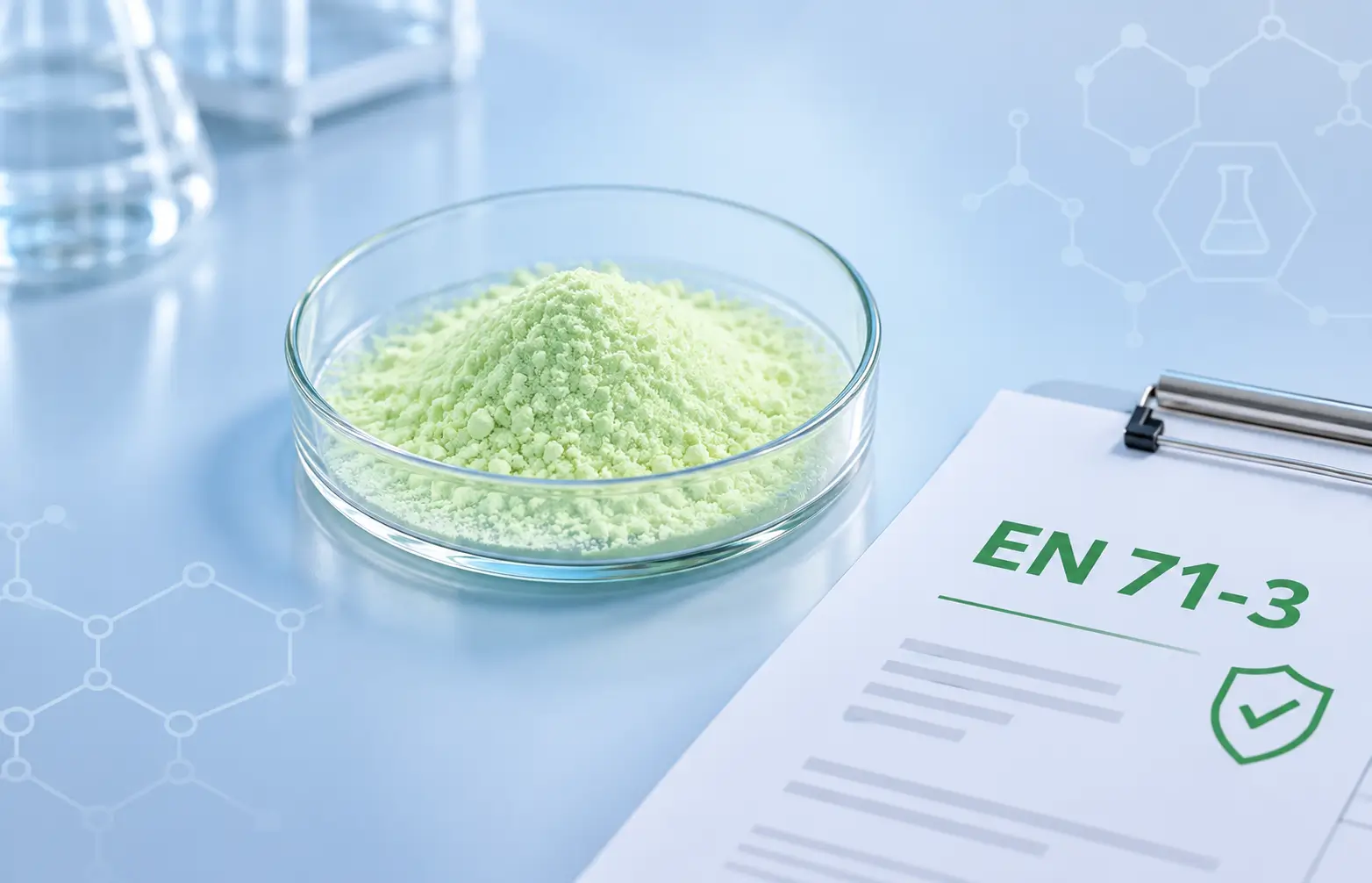
Can Glow-in-the-Dark Powder Pass EN 71-3 Testing?
In recent years, glow-in-the-dark powder has been increasingly used in tableware, children’s toys, baby products, and other consumer goods. As a result, material safety has become an important concern for brands, manufacturers, and consumers.
One question we often receive is:
Can glow-in-the-dark powder pass EN 71-3 testing?
The concern is understandable.
If every raw material used in a product is safe, it may seem reasonable to assume that the finished product will also be safer.
However, EN 71-3 is a migration test, and the test result of a raw material cannot always be directly equated with the actual safety performance of the finished product.
Glow-in-the-dark powder is a functional pigment. Depending on the application, it may remain as a raw powder, or it may be dispersed, encapsulated, and fixed within plastics, coatings, silicone, or other material systems.
These different material states can show significantly different element migration behavior.
1. What Does EN 71-3 Actually Test?
EN 71-3 ↗ is the part of the European toy safety framework ↗ concerning:
Migration of Certain Elements
It does not measure only the total amount of an element contained in a material.
Instead, it measures how much of certain elements can migrate out of the material under specified test conditions.
The basic principle is to extract potentially migratable elements from toy materials using an acidic medium designed to simulate conditions after the material is swallowed and exposed to the gastric environment.
The migration levels of specified elements such as Sr, Pb, Cd, Cr, Hg, and others are then measured.
Total Content ≠ Migration
For strontium aluminate glow-in-the-dark powder, this distinction is particularly important.
2. Why Is Sr Migration a Common Issue for Strontium Aluminate Glow Powder?
The most widely used high-brightness, long-afterglow photoluminescent pigments today are based on rare-earth-activated strontium aluminate.
A typical yellow-green glow powder is based on:
SrAl₂O₄:Eu,Dy
Sr is Strontium.
Strontium is part of the crystal structure of strontium aluminate itself. It is not simply an impurity that has accidentally entered the material.
EN 71-3 uses acidic conditions to simulate the gastric environment after a material is swallowed. Under these acidic conditions, the strontium aluminate crystal can be attacked, allowing Sr to be released.
For this reason, Sr migration is often the main issue when conventional strontium aluminate glow powder is tested according to EN 71-3.
This is also one of the main reasons why raw strontium aluminate pigment can have difficulty meeting the corresponding migration limit.
For raw glow-in-the-dark powder, which is a powder-like material, the sample would normally be evaluated under:
Category I — Dry, brittle, powder-like or pliable materials
The Sr migration limit for this category is:
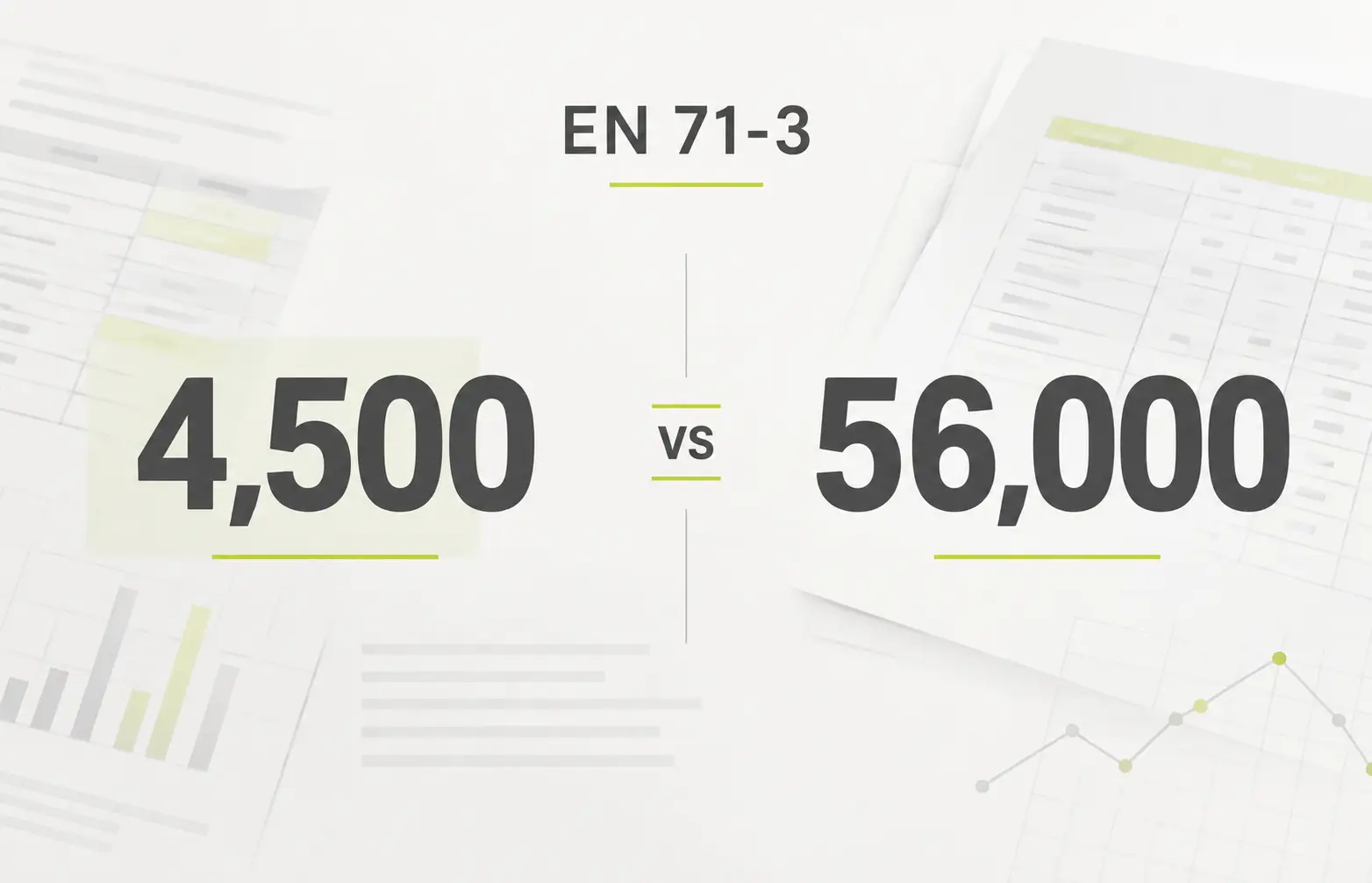
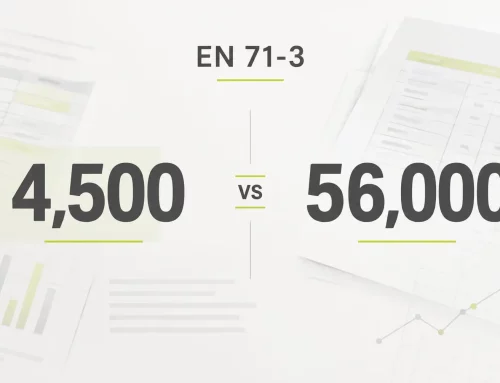
4,500 mg/kg
EN 71-3 specifies different migration limits for different material categories.
If you would like to understand why some EN 71-3 reports show an Sr limit of 4,500 mg/kg, while others show 56,000 mg/kg, you can refer to our separate article explaining EN 71-3 material categories and how to read an EN 71-3 test report.
3. Does This Mean Strontium Aluminate Glow Powder Is “Unsafe”?
It should not be understood that simply.
The purpose of EN 71-3 is to evaluate:
How much of certain elements may migrate from a material if the material is actually contacted or ingested by a child?
Therefore, if the material being evaluated is exposed glow powder itself, or if the glow pigment can be easily exposed and potentially ingested in the finished product, the migration performance of the raw photoluminescent material becomes very important.
However, if the glow powder is sufficiently encapsulated and fixed within the substrate of the finished product, and consumers are unlikely to come into direct contact with the powder itself, it is generally more meaningful to evaluate the migration and safety performance of the processed material or the finished product.
This is why:
A raw glow pigment failing EN 71-3 does not automatically mean that every finished product made with that pigment is unsafe.
4. Why Can Sr Migration Differ Between Raw Pigment, Masterbatch, and Injection-Molded Plastic Cups?
In one glow-in-the-dark plastic cup project for an international brand, we analyzed the safety test results together with the customer.
We found that Sr migration could vary significantly depending on whether the glow material was present as:
- raw photoluminescent pigment;
- high-concentration glow masterbatch; or
- a lower concentration of glow pigment dispersed throughout the final injection-molded plastic product.
In other words:
Sr migration is influenced not only by the glow powder itself, but also by how the pigment exists within the finished material, how well it is encapsulated, and the amount used.
We therefore carried out further EN 71-3 testing on the glow masterbatch.
The test results showed that the masterbatch could pass the corresponding EN 71-3 test.
The customer subsequently completed the other necessary safety and regulatory evaluations for the finished product. The relevant tests were successfully completed, and the product was ultimately launched on the market.
This case demonstrates that the safety of an entire finished glow-in-the-dark product should not be judged only by the EN 71-3 result of the raw glow pigment.
A more meaningful evaluation should consider the actual formulation, substrate, addition level, product structure, and the material that consumers may actually come into contact with.
5. Why Can Some Surface-Coated Products Still Fail?
Not every finished product containing glow-in-the-dark powder behaves like injection-molded plastic.
For example, if the photoluminescent pigment is incorporated into a surface ink or paint coating, and the cured coating can still be scraped or removed from the product surface, the exposure condition of the glow material is very different from pigment that is encapsulated inside injection-molded plastic.
We have encountered this type of project.
A glow-in-the-dark coating was printed onto the surface of a fabric toy. The customer carried out EN 71-3 testing on the actual coating material scraped from the product surface, and the result showed excessive Sr migration.
This does not contradict the plastic cup example above.
Instead, it demonstrates an important point:
The final physical state of a glow material can directly affect migration behavior and safety evaluation.
Glow pigment particles that are sufficiently encapsulated within plastic are generally less likely to be directly exposed.
In contrast, glow particles contained in a surface coating that can be scraped or worn away are more likely to become exposed during use.
For this reason, applications with greater potential for direct exposure may require stricter consideration of the migration performance of the glow material itself.
6. Why Is Zinc Sulfide Glow Powder Different?
In addition to long-afterglow strontium aluminate glow powder, there is another traditional type of short-duration photoluminescent material:
Zinc Sulfide (ZnS)
ZnS has a different chemical composition from strontium aluminate and does not contain Sr.
Therefore, it does not have the same high-Sr-migration issue associated with strontium aluminate glow powder.
We have seen actual cases in which zinc sulfide glow pigment passed EN 71-3 testing.
However, an important distinction should still be made:
EN 71-3 PASS does not mean that a material is automatically safe for every possible application.
EN 71-3 evaluates the migration risk of 19 specified elements or element species covered by the standard.
It is not a single comprehensive safety assessment covering every possible chemical, toxicological, food-contact, or long-term-use risk.
For example, ZnS may release hydrogen sulfide under strong acidic conditions. This type of issue cannot be fully evaluated simply from an EN 71-3 PASS result.
Therefore, whether using strontium aluminate or zinc sulfide, the material should be selected according to the actual application and expected exposure conditions of the finished product.
7. What Should Be Tested: Raw Pigment, Processed Glow Material, or the Finished Product?
There is no single answer that applies to every glow-in-the-dark product.
The more important question is:
What glow-containing material will the consumer actually come into contact with in the finished product?
If the glow powder remains directly exposed in a form close to the raw pigment, testing the raw pigment itself can be highly relevant.
If the glow powder has already been incorporated into an ink, coating, plastic, silicone, or another material system, and the consumer actually contacts the processed material rather than the exposed powder, the test sample should ideally represent that actual state as closely as possible.
Depending on the final material and how the sample is obtained, this may involve the relevant EN 71-3 material category, such as:
Category II — Liquid or sticky materials
or
Category III — Scraped-off materials
In other words:
The test sample should represent the material that consumers can realistically be exposed to, rather than automatically requiring every project to test the raw glow-in-the-dark powder.
Conclusion: Raw Pigment Fails ≠ Finished Product Is Unsafe
For conventional strontium aluminate glow powder, Sr is an inherent part of the crystal structure.
Under the acidic migration conditions used in EN 71-3, raw strontium aluminate powder can therefore have difficulty meeting the applicable Sr migration limit.
However, this does not mean that every finished product made with strontium aluminate photoluminescent pigment is unsafe.
The physical state and exposure conditions of glow particles can be very different in:
- raw glow powder;
- processed glow-containing materials;
- and finished glow-in-the-dark products.
A meaningful safety evaluation should therefore consider:
- the substrate into which the glow powder is incorporated;
- the addition level;
- whether the pigment is sufficiently encapsulated and fixed;
- whether the glow material can become exposed or detached;
- and what material consumers can actually come into contact with.
The safety of a finished product should be evaluated together with the actual physical state of the glow material, the likely exposure route, and the intended conditions of use.
This provides a more scientifically meaningful assessment that is closer to the way the finished product is actually used.



 + 86(411) 82479386

 Global Financial Center, No. 33 Huizhan Road, Shahekou District, Dalian, China