EN 71-3 Glow Powder Reports: Why 4,500 vs 56,000 mg/kg Sr?
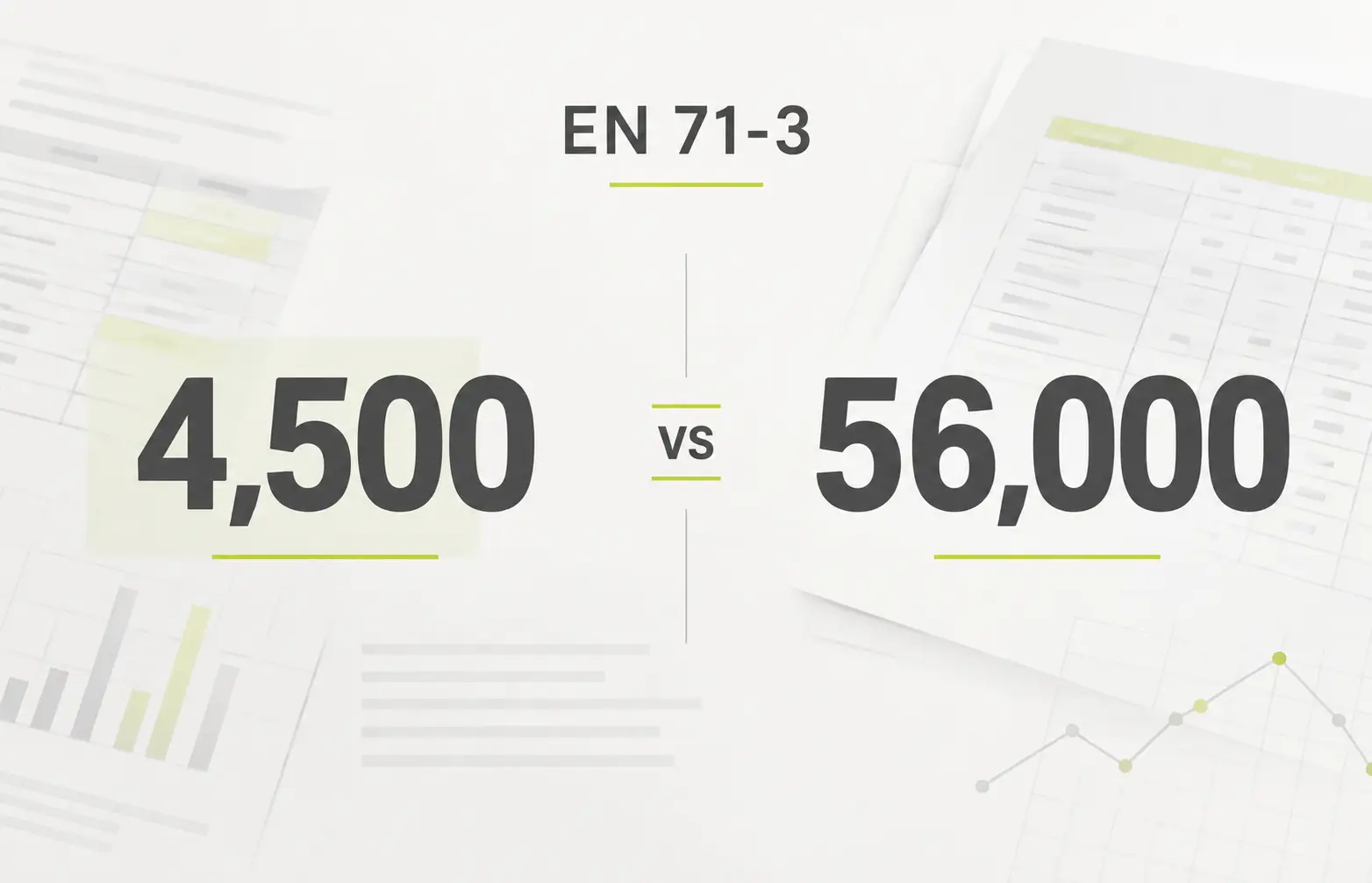
Why Do Some EN 71-3 Reports Show a Strontium Limit of 4,500 mg/kg, While Others Show 56,000 mg/kg?
Many customers who use glow-in-the-dark powder in toys or children’s products ask suppliers for an EN 71-3 test report. The reason is simple: they want to make sure the glow-in-the-dark pigment they purchase is safe.
However, when comparing EN 71-3 reports from different glow powder suppliers, you may notice something confusing: for the same element, Strontium (Sr), some reports show a limit of 4,500 mg/kg, while others show 56,000 mg/kg.
Why is there such a large difference? More importantly, if a report says PASS, does that automatically mean that the glow-in-the-dark powder itself has passed EN 71-3?
Not necessarily. The key is to understand which Material Category was used in the report.
1. What Does EN 71-3 Actually Test?
EN 71-3 is the part of the European toy safety standard that covers the Migration of Certain Elements.
It does not simply measure the total amount of an element contained in a material. Instead, it evaluates how much of certain elements may migrate from the material under specified acidic test conditions designed to simulate what may happen if toy material is licked, chewed, or swallowed by a child.
During the test, the sample is treated with an acidic medium, and the migration levels of 19 specified elements or forms of elements are measured, including lead, cadmium, mercury, arsenic, antimony, barium, selenium, strontium, zinc, and others.
For glow-in-the-dark materials, Strontium (Sr) is particularly important.
2. Why Is Sr Especially Important for Glow-in-the-Dark Powder?
The most widely used high-brightness, long-afterglow glow-in-the-dark powders are based on rare-earth-activated strontium aluminate. A typical yellow-green long-afterglow pigment can be represented as SrAl₂O₄:Eu,Dy.
The Sr in this formula is Strontium. In other words, strontium is not an accidental impurity in the pigment. It is part of the strontium aluminate crystal itself.
Under the acidic migration conditions used in EN 71-3 testing, the strontium aluminate crystal may be attacked by the acidic environment, allowing some Sr to be released.
For this reason, Sr migration is often one of the most important elements to examine when evaluating conventional strontium-aluminate glow-in-the-dark powder under EN 71-3.
Why does one EN 71-3 report use an Sr limit of 4,500 mg/kg, while another uses 56,000 mg/kg?
The answer depends on the Material Category assigned to the tested sample.
3. EN 71-3 Uses Different Material Categories, and the Sr Limits Are Very Different
EN 71-3 classifies materials into three categories, and the applicable Sr migration limit changes significantly depending on the category.
| Material Category | Material Type | Sr Migration Limit |
|---|---|---|
| Category I | Dry, brittle, powder-like or pliable materials | 4,500 mg/kg |
| Category II | Liquid or sticky materials | 1,125 mg/kg |
| Category III | Scraped-off materials | 56,000 mg/kg |
As you can see, the Sr limit for Category III is more than 12 times higher than the limit for Category I. This is why two EN 71-3 reports can show very different Sr limits even though both are testing Strontium.
4. Which Category Should Raw Glow-in-the-Dark Powder Be Evaluated Under?
If the sample submitted to the laboratory is the raw material itself, such as Photoluminescent Pigment or Glow-in-the-Dark Powder, then the physical form of the tested material is a powder.
When the raw pigment itself is being evaluated as a powder-like material, the relevant category is Category I — Dry, brittle, powder-like or pliable materials, with an Sr migration limit of 4,500 mg/kg.
Category II mainly covers liquid or sticky materials, such as certain liquid or viscous toy materials, and would normally not describe a dry glow-in-the-dark powder.
Category III applies to scraped-off materials, such as certain cured paints, coatings, and other materials removed from a finished toy for testing.
Therefore, when reviewing an EN 71-3 report for raw glow-in-the-dark powder, it is important not only to check what sample was submitted, but also whether the Material Category used in the report corresponds to the actual form of the tested material.
For raw photoluminescent pigment, the selected material category directly affects the applicable Sr limit and therefore the final PASS / FAIL judgment.
5. Why Is It Not Enough to Look Only at “PASS” on an EN 71-3 Report?
This is one of the most important points we want users of glow-in-the-dark materials to understand.
Suppose an EN 71-3 test report shows an actual Sr migration result of 8,000 mg/kg. The final judgment can change completely depending on which material category is used.
Sr result: 8,000 mg/kg
Limit: 4,500 mg/kg
Sr result: 8,000 mg/kg
Limit: 56,000 mg/kg
The measured Sr migration value has not changed. Only the material category has changed, yet the final conclusion is completely different.
This is why a simple PASS on the last page of a report does not tell the whole story. When reviewing an EN 71-3 report for glow-in-the-dark powder, at least three things should be checked together.
1. Sample Description — What Was Actually Tested?
Was the test sample raw pigment, masterbatch, coating, finished plastic, or another material?
2. Material Category — Was the Sample Classified Correctly?
Was it evaluated as Category I, Category II, or Category III?
3. Migration Result and Limit — What Were the Actual Numbers?
What was the measured migration value, and what limit was used to determine PASS or FAIL?
Only when these three pieces of information correspond with each other can the report provide meaningful information about the tested material.
6. Does Every Raw Glow-in-the-Dark Pigment Need to Pass EN 71-3 for the Final Product to Be Safe?
This is another question we often encounter, and the answer is not necessarily.
A key question is whether children can actually come into direct contact with, or ingest, the glow-in-the-dark powder during normal use of the final product. The answer can be very different depending on the application.
If you want to understand in more detail why the EN 71-3 result of a raw glow pigment does not always determine the result of the finished product, see our article on EN 71-3 testing of glow-in-the-dark powder.
The following two examples show why.
Case 1: Injection-Molded Glow-in-the-Dark Plastic Cup — Pigment Encapsulated in Plastic
In injection-molded plastic products, glow-in-the-dark powder can be added directly to the polymer or first made into a glow masterbatch and then added during production.
In either case, after melting and molding, the glow pigment is dispersed and fixed inside the polymer matrix. The child ultimately comes into contact with the glow-containing plastic material rather than loose glow powder.
In this situation, evaluating the actual plastic material containing the pigment may be more meaningful than looking only at the raw powder.
To compare the Sr migration behavior of glow materials in different states, we have tested both raw glow-in-the-dark pigment and glow masterbatch under EN 71-3.
The results showed that conventional strontium-aluminate glow powder in its raw powder form can have difficulty meeting the corresponding Sr migration requirement, while its migration behavior can be very different after the pigment is incorporated into a polymer system and made into masterbatch.
In our testing, the glow masterbatch was able to pass the corresponding test.
This comparison shows that the migration behavior of a glow material can be closely related to the physical state in which it exists in the final material. A single test result from the raw pigment should therefore not automatically be used to judge the safety of the finished product.
We have also worked with international brands on glow-in-the-dark injection-molded products. In these projects, the required safety testing was carried out based on the actual finished products, and the products were successfully brought to market.
Case 2: Glow-in-the-Dark Slime — Glow Pigment Is More Directly Exposed
Glow-in-the-dark slime is a very different situation.
In this type of product, the glow powder is usually physically mixed into the slime matrix. Unlike injection-molded plastic, the pigment particles are not necessarily fully encapsulated and fixed inside a solid polymer structure.
During squeezing, stretching, and playing, children may have more direct contact with the glow pigment, and hand-to-mouth contact may also increase the possibility of ingestion.
In this type of high-contact application, the migration safety of the glow material itself becomes much more important.
If a strontium-aluminate glow pigment cannot meet the relevant EN 71-3 requirements for the intended application, it may not be suitable for direct use in this type of product.
A more suitable glow material should be selected, and the final slime product should then be evaluated according to its actual material category and use condition.
So the same glow-in-the-dark pigment may be suitable for an injection-molded plastic product in which it is well encapsulated, but may not be suitable for glow-in-the-dark slime where the pigment is much more directly exposed.
This is not a contradiction. The difference is the exposure condition.
Conclusion: Safety Is More Than Finding a Report That Says “PASS”
An EN 71-3 report is important when evaluating glow-in-the-dark materials, but the word PASS alone is not enough.
You also need to confirm what material was actually tested, whether the correct Material Category was used, what the measured migration value was, and what limit was applied.
For strontium-aluminate glow-in-the-dark powder, the migration result of the raw pigment is useful information. However, when evaluating the safety of a finished product, it is also important to consider how the glow pigment exists in the final material and how consumers may actually be exposed to it.
The test sample should therefore be selected according to the real material state and exposure conditions of the final application.
If you are developing toys, children’s products, or other applications that require EN 71-3 evaluation, you can tell us about your substrate, manufacturing process, and intended use.
We can help you understand how the glow material exists in your final product and discuss which testing approach may be more appropriate for your application.



 + 86(411) 82479386

 Global Financial Center, No. 33 Huizhan Road, Shahekou District, Dalian, China