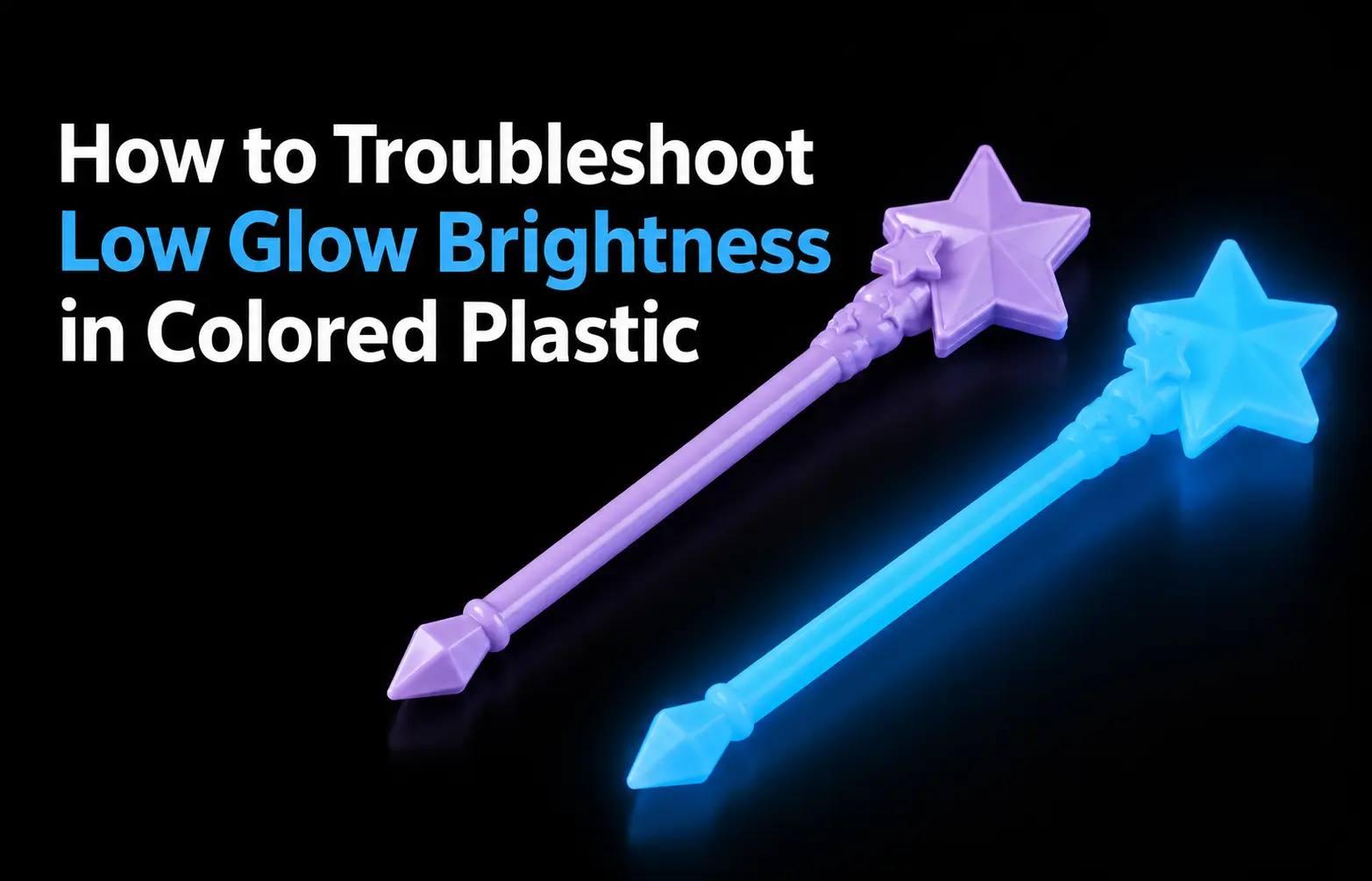
How to Troubleshoot Low Glow Brightness in Colored Plastic
In the injection molding of colored glow-in-the-dark plastic products, there are cases where the same glow pigment and the same addition ratio can still produce noticeably different glow performance.
Recently, one of GlowUp’s customers encountered this issue while developing a purple glow-in-the-dark plastic product.
By comparing the daytime color, light transmission, and glow performance of two actual samples, we analyzed several possible factors step by step and provided recommendations for the customer’s next round of testing.
1. The Problem: Why Does the Darker Purple Glow Brighter?
The customer wanted to reproduce the glow performance of an existing purple glow-in-the-dark plastic product.
Both samples used the same model of sky-blue glow pigment supplied by us, at the same addition ratio. However, the final results were clearly different:

| Comparison | Reference Sample | Trial Sample |
|---|---|---|
| Daytime Color | Darker purple | Lighter purple |
| Glow Performance | Brighter | Weaker |
Under otherwise similar conditions, the darker a plastic is colored, the more light it may block, and the weaker the glow may become.
But in this case, the opposite happened: the darker reference sample glowed more brightly than the lighter trial sample.
Why?
2. Step One: Check the Light Transmission
Faced with this unexpected result, the first thing we suggested was to compare the light transmission of the two samples.
A simple way to do this is to hold the samples up toward sunlight and observe which one allows more light to pass through.
The result was:
- Reference Sample: darker purple, but relatively more transparent.
- Trial Sample: lighter purple, but noticeably less transparent.
This was an important observation.
Glow pigment needs to absorb light energy and release it in the dark. When it is embedded inside plastic, both the ability of light to enter the material and the ability of the emitted glow to pass back out can affect the final glow performance.
A plastic product with a darker body color but better light transmission can therefore glow more brightly than a lighter-colored plastic with stronger hiding power.
GlowUp has previously conducted a comparison between transparent ABS and solid-colored ABS. With the same glow pigment addition ratio, the transparent ABS showed noticeably better glow performance.
3. Step Two: Why Is the Darker Sample More Transparent?
After confirming the difference in light transmission between the two samples, we began to analyze several possible factors.
Possibility 1: Lower Glow Pigment Concentration
First, the addition ratio of glow pigment may affect the transparency of the plastic.
Glow pigment itself consists of solid particles. Reducing the amount added will usually also reduce light scattering. Therefore, under otherwise similar conditions, plastic containing a lower proportion of glow pigment may appear more transparent.
However, too little glow pigment also means that less luminescent material is available to absorb and emit light, so the final brightness may be reduced.
Returning to this case, the reference sample was not only more transparent but also brighter. More importantly, we had already confirmed that both samples used the same glow pigment model and the same addition ratio.
Therefore, a difference in glow pigment concentration could not explain the result observed in this case.
Possibility 2: Different Hiding Power of Purple Colorants
The second factor worth examining was the purple coloring material itself.
Different types of pigments can produce similar purple colors while having very different hiding power and light transmission characteristics.
Some pigments have strong hiding power, meaning that even when the visible color appears relatively light, it may still be difficult for light to pass through the plastic. Other coloring materials may have lower hiding power and maintain better light transmission even when the final color appears darker.
This possibility was consistent with the behavior of the two samples.
The reference sample had a darker purple color but remained relatively transparent, suggesting that its coloring system may have lower hiding power. The trial sample, although lighter in color, may have used a pigment with stronger hiding power, which could have affected its glow performance.
Fluorescent pigments or fluorescent color pastes are usually our preferred coloring materials for this type of application. Based on our previous experience, a suitable fluorescent coloring system can provide a vivid daytime color and may also have a positive effect on the final glow performance through better light transmission and its own fluorescent properties.
Possibility 3: Metal Contamination During Injection Molding
Another possible factor is related to the injection molding process.
Glow pigment is relatively hard. If significant friction or wear occurs between the glow pigment and metal components such as the screw or barrel during processing, small amounts of metal contamination may enter the plastic.
This type of contamination may cause the plastic body color to become grayish, reduce transparency, and also affect glow performance.
In uncolored or transparent plastics, this kind of abnormality may sometimes be identified through a change in body color. In a product that already contains purple colorant, however, a slight gray cast may be masked and may not be easy to detect visually.
In this case, however, the customer is an experienced manufacturer that has been producing glow-in-the-dark injection-molded products for a long time and is already familiar with the processing characteristics of glow pigment and the relevant equipment conditions.
For this reason, we considered abnormal friction or metal contamination less likely and did not treat it as the primary factor in this case.
4. Step Three: Our Recommendation — Test a Different Purple Colorant
Based on the analysis above, our recommendation was to first confirm the type of purple colorant currently being used.
If the customer is not already using a fluorescent pigment or fluorescent color paste, a fluorescent coloring system suitable for the plastic processing conditions can be tested.
During the test, the glow pigment model, addition ratio, plastic base material, and main injection molding conditions should remain the same. Only the coloring system should be changed.
The customer can then compare three results:
- Daytime Color: Can the sample achieve the target purple color?
- Light Transmission: When held up to the light, does the light transmission improve?
- Glow Performance: Under the same charging conditions, does the glow brightness improve?
If changing the coloring material allows the plastic to maintain the target purple color while also achieving better light transmission and glow performance, this would indicate that the coloring system is an important factor contributing to the problem.
If there is no obvious improvement, the next step would be to continue checking the production process, including addition ratios, the plastic base material, processing conditions, and other factors that may affect light transmission.
At present, this project is still in the subsequent testing stage, so we are not treating the coloring material as a confirmed final cause.
Based on the performance of the samples currently available, however, this is the direction we consider most worth testing first.
5. What Can We Learn from This Case?
For manufacturers developing colored glow-in-the-dark injection-molded products, if the final glow brightness is lower than expected, the following checks can be used as an initial troubleshooting sequence:
- Check the glow pigment first: Confirm that the pigment model, supplier, and actual addition ratio are consistent.
- Compare light transmission: Do not judge only by the depth of the daytime color. Use backlighting to compare how easily light passes through each sample.
- Check the coloring system: If the same glow pigment produces different brightness levels, especially when the lighter-colored sample is less transparent, review the type of colorant, its hiding power, and its addition ratio.
- Check processing factors: If the plastic shows an unusual gray cast or reduced transparency, abnormal friction, metal contamination, or other injection molding issues may also need to be considered.
When comparing different samples, product thickness, charging conditions, and the timing of glow observation should also be kept as consistent as possible. Otherwise, differences in these conditions may affect the comparison.
Developing Colored Glow in the Dark Plastic?
GlowUp provides glow pigments for plastic processing methods such as injection molding and extrusion, as well as glow masterbatches for plastic applications. We also work with customers based on their actual product requirements and production conditions to help analyze issues encountered during product sampling.
If you are developing a colored glow-in-the-dark plastic product, or encountering issues related to brightness, color, or processing, you are welcome to discuss your product application, plastic base material, and test results with us.
Based on the actual project conditions, we can work with you to identify more suitable materials and determine practical directions for further testing or improvement.



 + 86(411) 82479386

 Global Financial Center, No. 33 Huizhan Road, Shahekou District, Dalian, China