
The Difference Between Strontium Aluminate and Zinc Sulfide
The development of luminous powder has gone through three stages: the initial stage was natural mine, which was quickly eliminated because it contained radium and had radiation, it was harmful to the human body. The second stage was short-afterglow Zinc Sulfide, and the third stage was the most common long-afterglow Strontium Aluminate.
Zinc Sulfide and Strontium Aluminate luminous powders do not contain radiation, and are safe to the human body, so they are gradually applied to commercial products. However, since the production of Zinc Sulfide generates waste gas and waste water, causing serious environmental pollution, and Zinc Sulfide luminous powder has a relatively short afterglow duration, many consumers now prefer longer illumination times. As a result, the third-generation long-afterglow Strontium Aluminate has emerged.
These two different types of luminous powder are very different and suitable for different applications and customer needs:
1. Different Colors
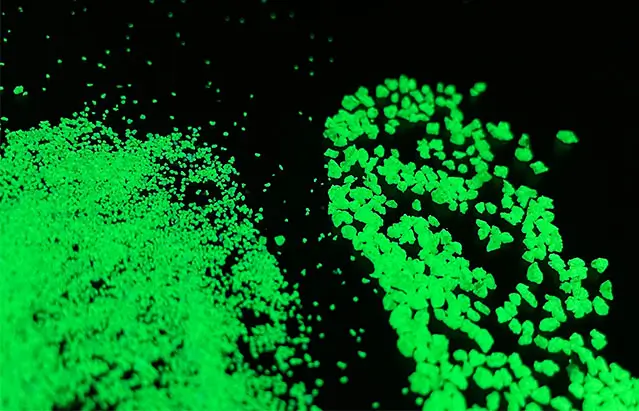
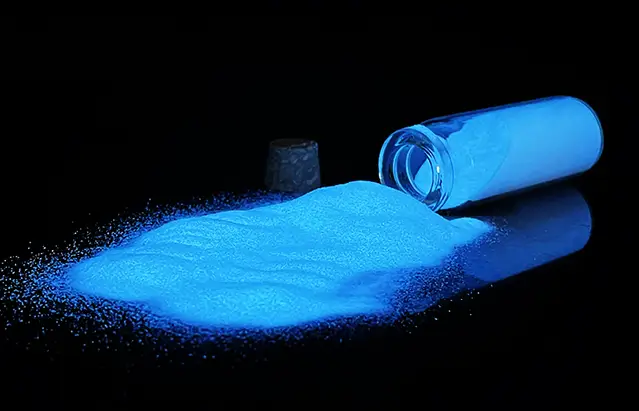
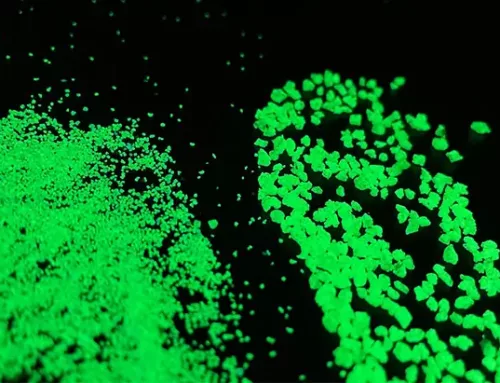
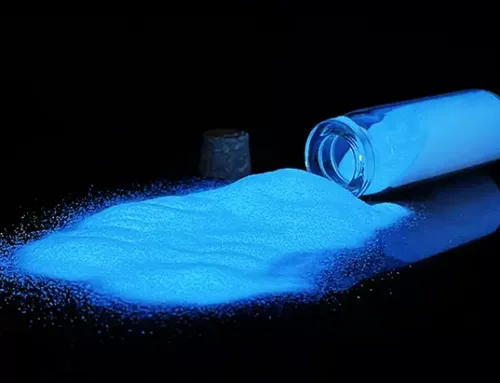
Strontium Aluminate luminous powders mainly have three colors: Yellow-Green, Blue-Green and Sky-Blue, as well as a variety of colored luminous powders derived from them. Zinc Sulfide luminous powders only have Yellow-Green.
2. Chemical Structure and Composition
The main component of strontium aluminate type is Strontium Aluminate (SrAl2O4). By doping with trace rare earth elements (such as europium Eu and dysprosium Dy) as activators and co-activators, a stable crystal structure is formed, which greatly prolongs the luminescence time.
The main component of Zinc Sulfide type is Zinc Sulfide (ZnS), which is usually doped with trace activators (such as copper Cu) to make it luminous, and does not contain rare earth. These activators change the electronic energy level structure of Zinc Sulfide, enabling it to absorb light and emit photons more efficiently. In addition, the crystal structure of Zinc Sulfide luminescent powder is simple.
3. Environmental Performance
Strontium Aluminate type does not produce harmful gases or water during the production process, and the waste can be recycled and reused, so it is an eco-friendly luminescent powder.
Zinc Sulfide type uses sulfur, which will produce sulfide waste gas and water during the production process. The copper-containing activator and its waste may also pollute water resources and soil. Therefore, its production is strictly controlled by the government.
4. Luminous Performance
- Light absorption speed:
Zinc Sulfide luminous powder has a faster light absorption speed. It can be illuminated by weak light such as mobile phone lights or LEDs for 3-5 seconds, and has a higher initial brightness immediately. But traditional strontium type cannot show the luminenscence as good as Zinc Sulfide type.

- Afterglow duration:
Strontium Aluminate luminous powder has the obvious advantage of longer afterglow duration. After fully absorbing light, it can maintain a luminous duration of 8-12 hours in a completely dark environment. Although zinc sulfide type has a higher brightness within the initial 1 minute, it decays rapidly and is difficult to be detected by the naked eyes after about 10 minutes even in an extremely dark place.

5. Application Cenarios
Strontium Aluminate luminous powder, known for its long afterglow properties, was widely used in early commercial applications for safety signs, emergency exit indicators, and other scenarios requiring prolonged visibility, such as office buildings, underground parking lots, warehouses, airports, and subway stations. Zinc Sulfide luminous powder is more used in areas with short-term luminous needs, such as toys, clock dials, etc.
However, with the increasing variety of consumer products and the expansion of market demand, longer luminous time and multiple colors have gradually become the mainstream luminous needs. As a result, Strontium Aluminate is now being widely used in consumer goods, such as clothing, toys, household items, accessorites, arts and etc,
6. Mixed Medium
- Water-based Coating:
- Plastic:
When mixed with water-based medium (water-based paint, water-based ink, water-based resin), Zinc Sulfide luminous powder is prone to hydrolysis after a period of time due to its weak stability. The product’s body color will get darken and the luminous effect will be weaken. While Strontium Aluminate type can be chemically coated, and the coated waterproof powder can be mixed with water-based medium. Certainly, the waterproof performance of these products varies depending on the specific formulations and technologies employed by different manufacturers.
When producing plastic products, Zinc Sulfide has obvious advantages. The use of Zinc Sulfide is less likely to cause the product to turn black, because its particle size distribution is narrow, as the result the friction during the production process is small. The particle size distribution of strontium luminous powder is relatively large, and it is easy to cause friction during the production, which may bring blackening problem, but its long afterglow characteristics attract many customers to try it.
Based on such needs, we developed a Plastic-Specific luminous powder with Strontium Aluminate base, which can minimize the possibility of blackening.
7. Substitute for Zinc Sulfide: YGZ
Due to the environmental protection requirements, the supply of Zinc Sulfide luminous powder is limited and its price keep rising. In order to meet the needs of customers who prefer Zinc Sulfide, we developed a Strontium Aluminate type as the replacement, named “YGZ”, with the same characters as Zinc Sulfide, but with higher brightness, .
Here is the comparizon technical data of Zinc Sulfide and YGZ. The testing condition is D65 light of 1000lux, charging for 5 seconds.
| Glowing Time | Brightness Data (mcd/㎡) |
|
|---|---|---|
| Zinc Sulfide | YGZ | |
| 10 seconds | 2782 | 5021 |
| 1 min | 478 | 1147 |
| 2 mins | 221 | 605 |
| 10 mins | 32 | 105 |
| 30 mins | 11 | 25 |
| 60 mins | 4 | 10 |
Beyong the brightness, another difference is glowing color. Zinc Sulfide type tends to appear more yellowish, while Strontium Aluminate shows more greenish luminescence.
In addition, we provide customized services for brightness performance. We can adjust the initial brightness and afterglow duration according to the special needs of the customer’s product usage scenario.
To sum up, Strontium Aluminate and Zinc Sulfide have their own characteristics, and can be selected according to specific demands.



 + 86(411) 82479386
 Global Financial Center, No. 33 Huizhan Road, Shahekou District, Dalian, China