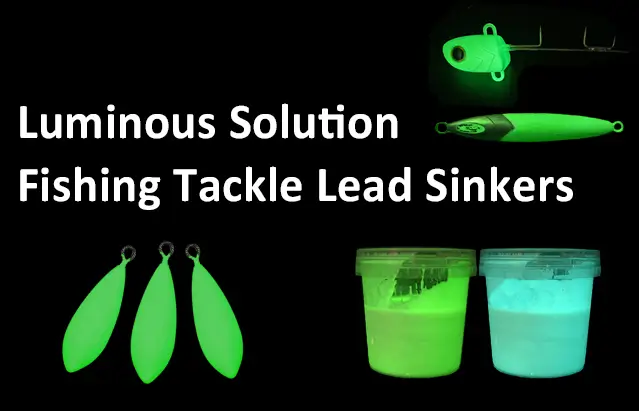
Luminous Coating Optimization for Fishing Tackle Lead Sinkers: Powder to Paint
With the rise of night fishing, market demand for luminous fishing gear continues to rise. Anglers are demanding higher performance in core areas like brightness and durability.
We recently received an inquiry from a luminous sinker manufacturer. He previously used glow powder directly. However, as market demand gradually expanded, he realized their production methods were inefficient and also the luminous performance couldn’t meet current market expectations. After researching and comparing various options, they decided to contact us for a professional and effective solution.
Background and Needs:
The customer’s manufacturing process is:
- Open-flame heating of the lead sinker: A flame torch is used to directly heat the lead sinker to a certain surface temperature, making it easier for powder to adhere.
- Applying a white powder base layer: White powder is evenly applied to the surface of the hot lead sinker. This powder acts as a binder and is then heated again to melt and adhere to the sinker.
- Sprinkling glow powder: Glow powder is evenly applied to the melted white powder.
- Further open-flame heating: A flame torch is used again to heat the lead sinker, ensuring that the glow powder adheres firmly to the white powder, forming a complete glow coating.
- Cooling: After the coating cools, the lead sinker is now glow-in-the-dark one.
The customer admitted that this direct powder application process is cumbersome and complex, and especially difficult to maintain in terms of process stability and efficiency in large-scale production. Therefore, he wanted to consider using paint directly, hoping to simplify the production process, improve coating uniformity and adhesion, and achieve a more stable and long-lasting glowing effect. However, he was unfamiliar with the luminous effects, properties, and application of luminous paint and sought our professional guidance.
However, the customer also expressed concerns about the brightness and adhesion of the luminous paint: If the luminous paint performance cannot match or exceed the existing powder solution, he might keep the current powder process.
Our Analysis: Disadvantages of the Current Powder Process with Open Flame Heating
Applying luminous powder directly to the lead sinker with an open flame heating process has certain disadvantages:
- High temperatures destroy the powder’s crystal structure, severely affecting its brightness: The center temperature of a flame from a blowtorch can reach approximately 2000°C, far exceeding the thermal stability range of luminous powder (up to 1450°C in an oxygen-free environment; see the “High Temperature Resistance” for details). In this case, the luminescent crystals of the powder will undergo physical and chemical changes, and its luminous intensity and duration will be significantly reduced
- Complex operation: This process requires at least three open flame heating steps, which is time-consuming and labor-intensive.
- Over-reliance on manual labor: This process requires a high degree of skill from the operator, who must precisely control heating temperature and duration. The photoluminescent powder must also be applied uniformly to ensure even coverage. Any deviation can result in uneven glow, leading to inconsistent quality among the luminous lead sinkers.
- Safety hazards from high-temperature open flame work: This type of working environment is prone to burns, fires, and other safety hazards, harboring multiple potential safety hazards.
We summarized these issues to the customer and recommended the following solution.
Recommended Solution: Using Ultra-Bright Luminous Paint with a Dedicated Hardner
This solution offers significant advantages in both product performance and production process:
- Ultra-bright luminous performance: Our glow paint uses ultra-bright glow- powder at a 40% addition ratio (the highest proportion after our testing). A single full charge provides over 12 hours of luminescence. The paint film also has a uniform surface, enhancing user’s experience.
- Safely room-temperature curing: The glow-in-the-dark paint typically dries within 1-2 hours at room temperature. No open flame is required, preventing damage to the glow powder caused by high temperatures and ensuring worker safety.
- Availability for assembly line production: Supports multiple application methods, including brushing, spraying, and dipping, significantly reducing process complexity and is more suitable for large-scale assembly line production.
- Strong adhesion: The use of a matching hardener provides strong adhesion, excellent wear resistance, and weather resistance, guaranteeing the coating’s long-term durability on the lead sinker surface.
Customer Feedback and Testing
After a comprehensive evaluation, the customer fully recognized our technical analysis and product solution, believing that glow paint offers significant advantages in simplifying the process, improving production efficiency, and ensuring a superior luminous effect. Therefore, they decided to take samples for an experiment.
To ensure the smooth implementation of the new solution, we provided a comprehensive set of technical support, including technical specifications for the luminous paint, application precautions and instructions. After a small-scale test run, the customer highly praised the paint’s adhesion, abrasion resistance, and overall luminous performance, and also appreciated the streamlined production process and significant efficiency improvements.
The customer stated that he has already begun retrofitting his existing production line, planning to fully implement the luminous paint solution in future large-scale production. He expressed his hope for a long-term partnership with us to jointly explore further innovative possibilities for luminous fishing gear products.



 + 86(411) 82479386
 Global Financial Center, No. 33 Huizhan Road, Shahekou District, Dalian, China